
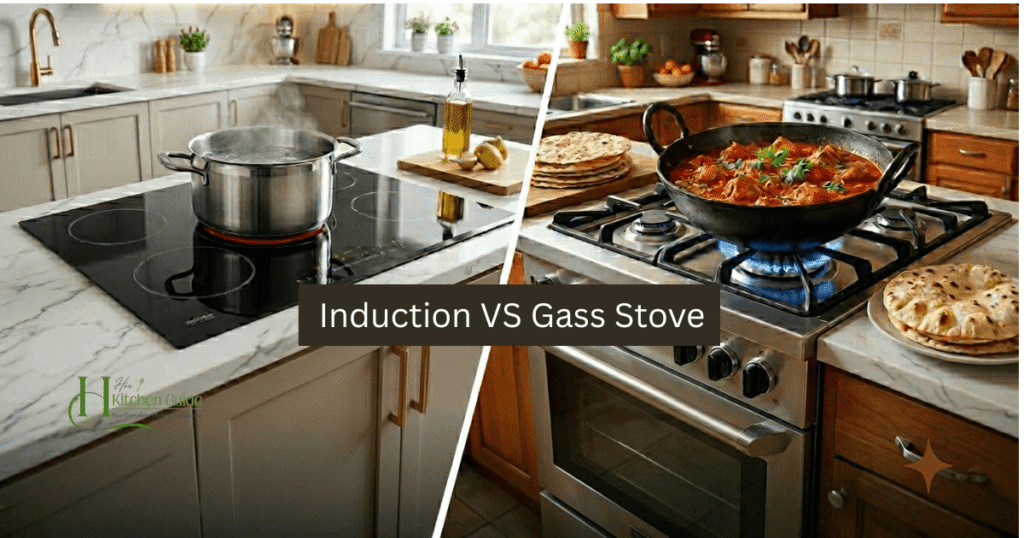
Rising gas prices, low gas pressure, and the growing popularity of induction cooktops have left many homeowners asking one important question: Which is better—an induction cooktop or a gas stove?
If you’re setting up a new kitchen or considering an upgrade, this decision can affect your monthly expenses, cooking experience, safety, and long-term savings. While gas stoves have been a trusted choice in many households for decades, induction cooktops are gaining popularity thanks to their energy efficiency, faster cooking, and modern features.
In this detailed Induction vs Gas Stove comparison, we’ll explore the pros, cons, running costs, safety, cooking performance, and whether you can make roti, paratha, and karahi on an induction cooktop. By the end of this guide, you’ll have a clear understanding of which option is truly better for your kitchen and lifestyle.
Table of Contents
Gas Stove vs Induction: What’s the Difference?
At first glance, both appliances do the same job: they help you cook delicious meals. However, the way they generate heat is completely different—and this difference affects everything from speed and energy efficiency to safety and monthly costs.
A gas stove uses an open flame powered by natural gas or LPG. The flame heats the bottom of your cookware, and that heat is transferred to your food. This traditional method has been used in homes for decades, which is why many people feel comfortable and confident using it.
An induction cooktop, on the other hand, uses electromagnetic technology to heat the cookware directly. Instead of heating the cooking surface first, induction creates a magnetic field that generates heat inside the pot or pan itself.
Because of this, very little heat is wasted.
This difference may sound technical, but it changes your everyday cooking experience.
With gas, some heat escapes into the surrounding air, often making the kitchen hotter. With induction, most of the energy goes directly into the cookware, which means faster cooking and a cooler kitchen.
In simple terms:
Gas cooks through a flame. Induction cooks through magnetic energy.
Neither option is automatically better. Understanding how they work simply helps you choose what fits your lifestyle best.
Gas Stove vs Induction: At a Glance
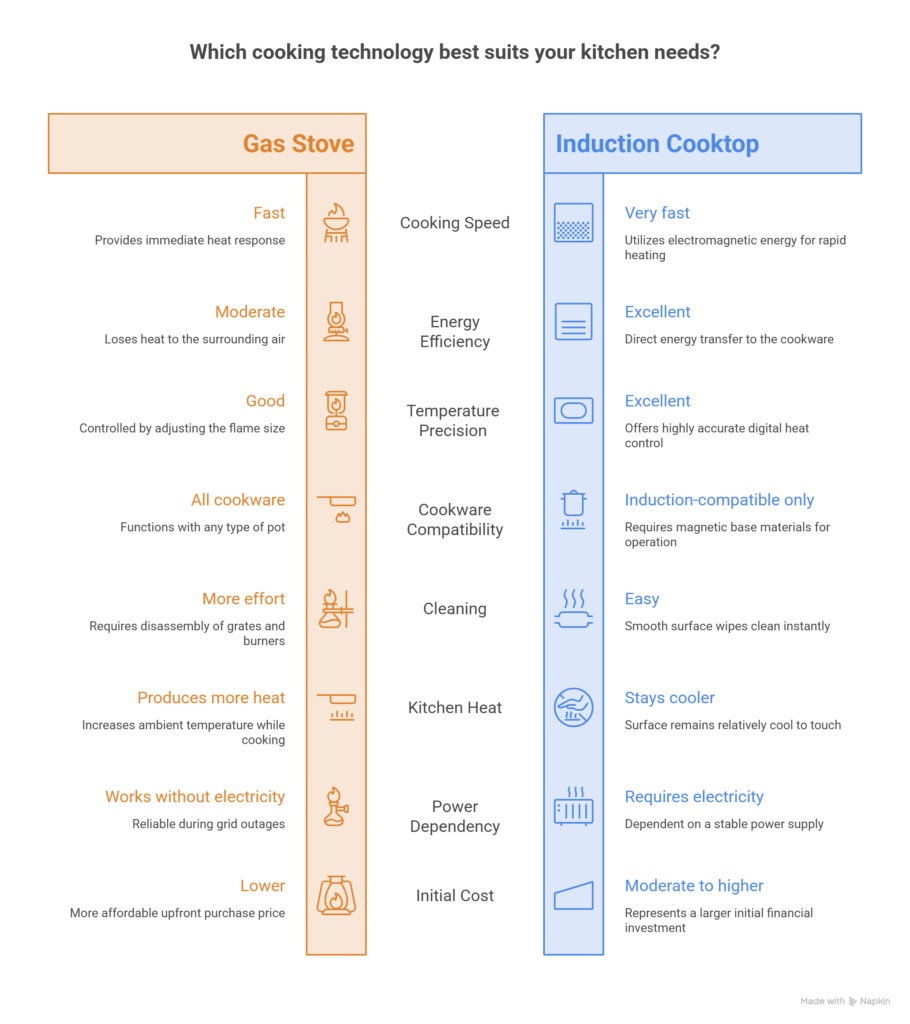
| Feature | Gas Stove | Induction Cooktop |
| Heat Source | Open flame | Electromagnetic energy |
| Cooking Speed | Fast | Very fast |
| Energy Efficiency | Moderate | Excellent |
| Temperature Precision | Good | Excellent |
| Cookware Compatibility | All cookware | Induction-compatible only |
| Cleaning | More effort | Easy |
| Kitchen Heat | Produces more heat | Stays cooler |
| Safety | Open flame | No open flame |
| Power Dependency | Works without electricity | Requires electricity |
| Performance During Power Cuts | Excellent | Limited |
| Initial Cost | Lower | Moderate to higher |
Induction vs Gas Stove: Which One Actually Cooks Better?
This is where things get interesting.
Specifications and efficiency ratings matter, but most people simply want to know:
“Which one helps me cook better food?”
The answer depends on what “better” means to you.
Speed: Induction Takes the Lead
If speed matters, induction is difficult to beat.
Because induction heats cookware directly, it wastes very little energy. Water can boil significantly faster compared to gas, helping busy families save valuable time during meal preparation.
Whether you’re boiling pasta, making tea, reheating leftovers, or preparing breakfast before work, the difference becomes noticeable.
Winner: Induction ✅
Temperature Control: It’s Surprisingly Close
Many home cooks love gas because they can see the flame.
Turning the knob instantly increases or decreases the heat, making it easy to adjust while cooking.
Induction, however, offers extremely precise control. Most models allow you to select exact heat levels, and they respond almost immediately to changes.
This makes induction excellent for:
- Simmering sauces,
- Melting chocolate,
- Delicate cooking,
- Maintaining consistent temperatures.
Gas still feels more intuitive to some experienced cooks, while induction offers greater precision.
Winner: Tie 🤝
Can You Make Roti, Paratha and Karahi on Induction?
This is perhaps the biggest concern in South Asian kitchens.
Many people assume induction is only suitable for soups and simple meals.
But can it handle everyday desi cooking?
The short answer is:
Yes—with a few adjustments.
Roti and Paratha
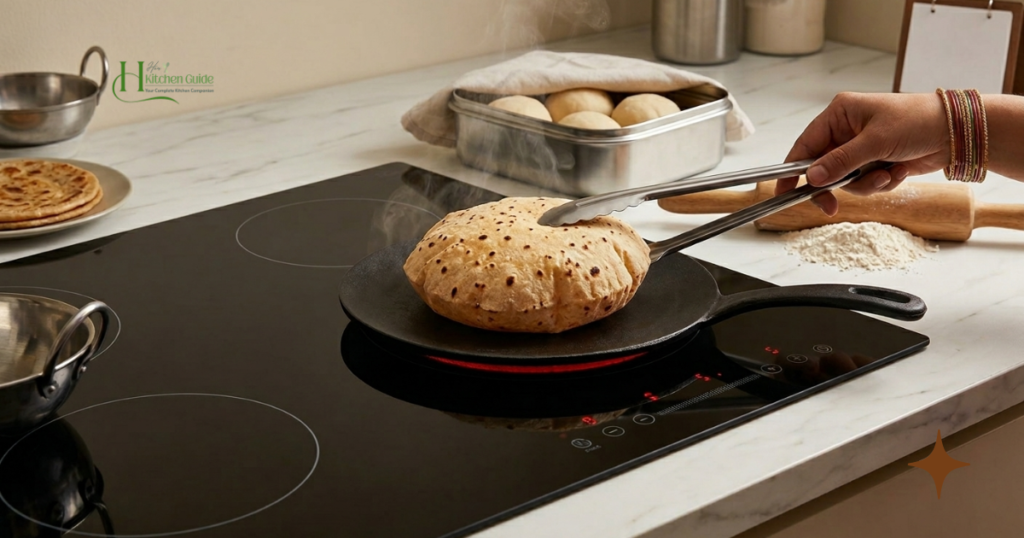
If you use an induction-compatible tawa, roti and paratha can be cooked successfully.
The texture may feel slightly different at first because there isn’t a direct flame underneath, but most families adapt quickly after a few uses.
One limitation is that traditional phulka puffing directly over an open flame isn’t possible on induction.
If perfectly puffed phulkas matter to you, gas still has an advantage.
Winner: Gas (slight edge) 🔥
Karahi and Bhunna
South Asian cooking often involves long periods of bhunna, stirring, and high heat.
The good news?
Induction can handle karahi dishes very well—as long as your cookware is compatible.
However, some cooks still prefer gas because:
- Flames provide visual feedback,
- It’s easier to lift and tilt pans,
- Traditional techniques feel more natural.
If authentic karahi cooking is central to your kitchen routine, gas may remain your favourite.
Tarka and Deep Frying
Induction performs surprisingly well for:
- Tarka,
- Frying onions,
- Deep frying,
- Cooking curries.
Its precise heat control can actually help prevent overheating.
However, if you frequently cook with very large utensils or rely heavily on flame-based techniques, gas may feel more comfortable.
Chai and Pressure Cooking
Daily essentials such as:
- Chai,
- Daal,
- Rice,
- Pressure cooker recipes,
work beautifully on induction.
Many users who switch to induction eventually find themselves reaching for it more often than expected for routine cooking.
So, Which One Wins for South Asian Cooking?
The honest answer?
Gas feels more familiar. Induction is more capable than most people realise.
If your cooking revolves around traditional flame techniques, gas still holds an advantage.
But if you’re open to adapting slightly, induction can easily handle the majority of everyday South Asian meals.
Running Costs: The Surprising Truth
When comparing Induction vs Gas Stove, monthly expenses are often the deciding factor.
Many households assume:
“Induction will destroy my electricity bill.”
Others believe:
“Gas is always cheaper.”
The reality is more complicated.
Gas Costs
Gas expenses depend on whether you use:
- Natural gas,
- LPG cylinders,
- Local tariffs,
- Your cooking habits.
For families relying on LPG, refill costs can become a noticeable monthly expense.
Low gas pressure may also increase cooking time, leading to greater usage.
Induction Costs
Induction uses electricity, which understandably worries many homeowners.
However, induction is highly energy-efficient.
Because most of the generated energy goes directly into the cookware, cooking often takes less time.
So while electricity usage exists, efficiency helps offset some of the cost.
Hidden Costs Most People Forget
Before making a decision, don’t overlook these factors:
Gas Hidden Costs
- Burner maintenance,
- Cleaning grates,
- LPG transportation,
- Potential leakage concerns.
Induction Hidden Costs
- Purchasing compatible cookware,
- Possible electrical upgrades,
- Higher upfront appliance cost.
Sometimes the cheapest option initially isn’t the cheapest in the long run.
Monthly Cost Comparison (Approximate)
| Factor | Gas Stove | Induction |
| Initial Appliance Cost | Lower | Moderate to Higher |
| Monthly Running Cost | Depends on gas tariffs/LPG usage | Depends on electricity rates and usage |
| Energy Efficiency | 40–60% | 85–90% |
| Cookware Upgrade | Not required | May be required |
| Maintenance | Moderate | Low |
| Lifespan | Long | Long |
Important: Running costs vary based on local utility rates, cooking frequency, family size, and appliance efficiency.
Energy Efficiency: Which Option Saves More Energy?
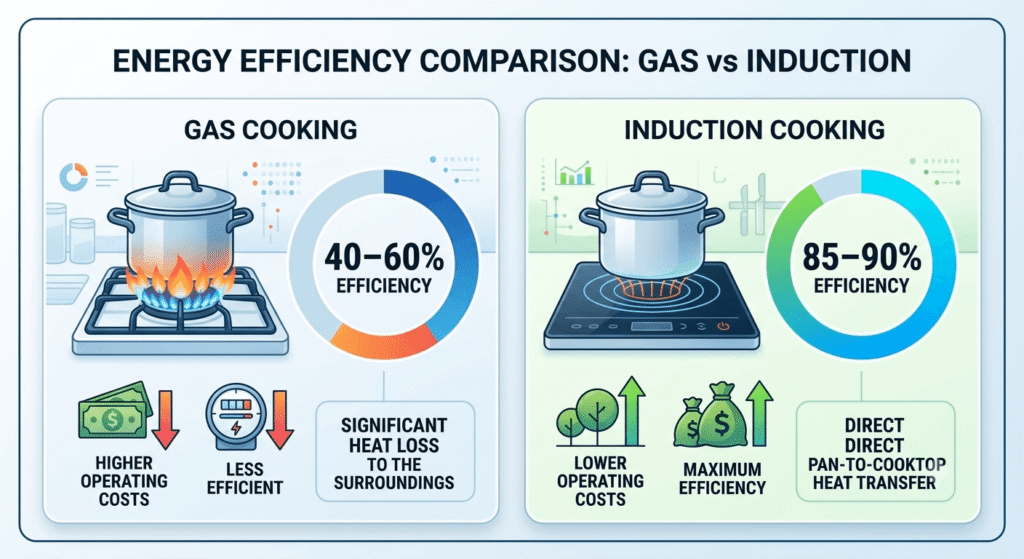
One of the biggest differences between an induction cooktop and a gas stove is how efficiently they use energy. Induction transfers heat directly to the cookware, while gas loses a significant amount of heat around the flame, making it less energy-efficient.
If reducing energy waste is important to you, induction has a clear advantage.
Gas stoves lose a significant amount of heat to the surrounding air. In fact, only around 40–60% of the energy produced actually reaches the cookware. The rest escapes into your kitchen.
Induction cooktops work differently. Since they heat the cookware directly, approximately 85–90% of the energy is transferred to the pan, making them one of the most energy-efficient cooking methods available today.
The U.S. Department of Energy also highlights induction cooking as an efficient way to reduce energy waste in the kitchen.
This higher efficiency means:
- Faster cooking times,
- Less wasted energy,
- A cooler kitchen environment,
- Better use of the electricity you’re paying for.
Winner: Induction ✅
However, efficiency isn’t the only factor to consider. Practicality matters too—and that’s where gas still has its strengths.
Safety & Health: Which One Is Safer?

Safety is often overlooked until you have young children, elderly family members, or simply want peace of mind in the kitchen.
Gas Stove Safety
Gas has been used for generations, but it does come with risks:
- Open flames can cause burns.
- Gas leaks can be dangerous if not detected quickly.
- Burners remain hot after cooking.
- Indoor emissions may affect air quality, especially in poorly ventilated kitchens.
According to the World Health Organization (WHO), household air pollution can negatively affect health, making proper kitchen ventilation important.
This doesn’t mean gas is unsafe. Millions of families use it every day. It simply requires greater awareness and proper ventilation.
Induction Safety
Induction was designed with safety in mind.
Many models offer features such as:
- No open flame,
- Automatic shut-off,
- Child lock settings,
- Pan detection technology,
- Surfaces that remain relatively cool to touch.
Because heat is generated inside the cookware rather than on the cooktop itself, the risk of accidental burns is reduced.
Winner: Induction ✅
Cooler Cooking in Summer: An Unexpected Benefit
Anyone who has cooked during peak summer knows this feeling:
Standing in front of a gas stove in June or July can make the kitchen feel like an oven.
Because gas flames release heat into the surrounding air, kitchens become noticeably warmer during long cooking sessions.
Induction generates very little ambient heat, helping your kitchen stay more comfortable.
This may sound like a small advantage, but during hot South Asian summers, many home cooks consider it a game-changer.
What Happens During Power Cuts?
This is where gas regains some ground.
In countries where power interruptions are common, reliability becomes a major factor.
Gas Stove
If natural gas supply is available, you can continue cooking even when electricity goes out.
Winner: Gas ✅
Induction Cooktop
Induction requires electricity to function.
During outages:
- Standard induction units stop working.
- Most basic UPS systems cannot support their high power requirements.
- Heavy-duty inverters or solar backup systems may be needed.
If frequent load shedding is part of your reality, relying entirely on induction may not be practical.
This is one reason many households choose a hybrid setup.
Which Cookware Works on Induction?
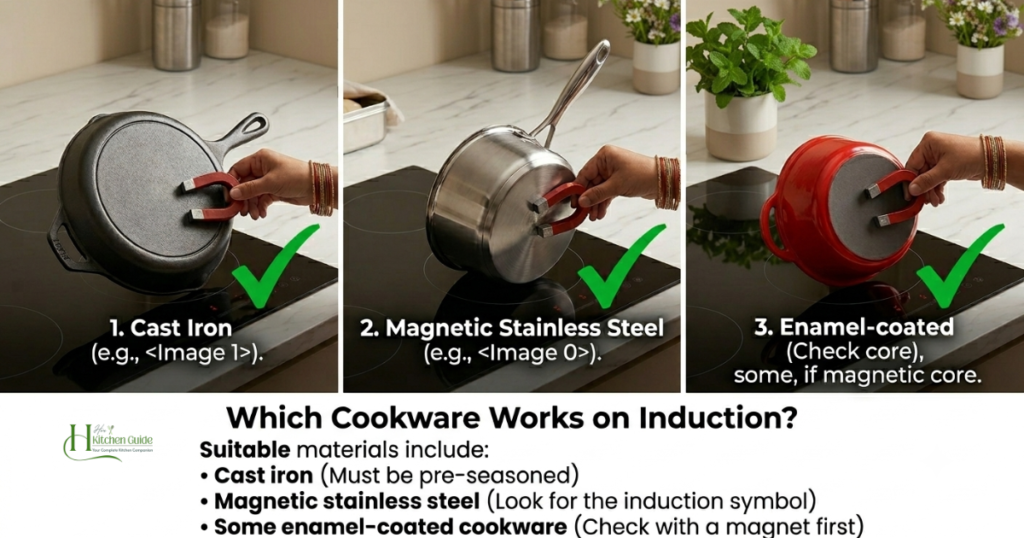
One of the biggest surprises for first-time buyers is discovering that not all cookware works on induction.
One of the biggest differences in the Induction vs Gas Stove comparison is cookware compatibility.
Induction-compatible cookware must have a magnetic base.
Suitable materials include:
- Cast iron,
- Magnetic stainless steel,
- Some enamel-coated cookware.
Generally not compatible:
- Aluminium,
- Copper,
- Glass cookware.
The Simple Magnet Test
Here’s an easy trick:
Place a magnet on the bottom of your pan.
If it sticks firmly, your cookware will most likely work on induction.
If it doesn’t stick, you’ll probably need replacement cookware.
This small test can save you money and frustration before making the switch.
Which One Is Easier to Clean?
Cleaning may not seem exciting, but after years of cooking, it becomes a big deal.
Gas Stove Cleaning
Cleaning usually involves:
- Removing grates,
- Scrubbing burners,
- Reaching difficult corners,
- Dealing with grease buildup.
It requires more effort and time.
Induction Cooktop Cleaning
Induction surfaces are smooth and flat.
Most spills can simply be wiped away with a damp cloth.
Because the surface doesn’t get extremely hot, food is less likely to burn onto it.
Winner: Induction ✅
Switching from Gas to Induction: What You Need to Know
Thinking about making the switch?
Before you buy, ask yourself these questions:
✓ Is your electrical system suitable?
Older homes may need electrical upgrades.
✓ Do you already own compatible cookware?
Use the magnet test before the Induction Cooktop
Winner: Induction ✅
More purchasing new utensils.
✓ How often do power cuts occur?
If outages are frequent, keep a backup plan.
✓ What type of cooking do you do most?
Daily chai and quick meals?
Or heavy-duty karahi cooking every day?
✓ What’s your long-term goal?
Lower maintenance?
Better safety?
Energy efficiency?
Answering these questions honestly will help you make the right decision.
Common Myths About Induction Cooktops
Myth 1: Induction food is harmful or radioactive.
Fact: False.
Induction uses electromagnetic energy to heat cookware. It does not make food radioactive.
Myth 2: You can’t cook desi food on induction.
Fact: False.
From daal and biryani to paratha and karahi, induction can handle most South Asian dishes with compatible cookware.
Myth 3: Induction always causes huge electricity bills.
Fact: Not necessarily.
Its high efficiency means electricity usage may be lower than many people expect.
Myth 4: Professional-quality cooking is only possible on gas.
Fact: Not anymore.
Many chefs around the world now use induction because of its speed and precision.
Induction vs Gas Stove FAQ
Is induction better than gas stoves?
Induction is generally safer, more energy-efficient, and easier to clean. Gas remains a strong choice for those who prefer cooking with an open flame and need reliability during power cuts.
Which is cheaper to run: gas or induction?
It depends on your local utility rates, cooking habits, and whether you use natural gas or LPG. Induction is more efficient, but exact costs vary by household.
Does induction significantly increase electricity bills?
Not always. Because induction transfers energy directly to cookware, it often cooks faster and wastes less energy.
Can induction work during power cuts?
Only if you have a suitable backup system, such as a heavy-duty inverter or solar setup.
Can you make roti on induction?
Yes. Roti and paratha can be cooked successfully using an induction-compatible tawa, although direct-flame phulkas are not possible.
What cookware works on induction?
Magnetic cookware, such as cast iron and magnetic stainless steel works best. Use the magnet test to check compatibility.
Do chefs prefer gas or induction?
Some chefs still prefer gas because of the visible flame, while many modern professionals appreciate induction’s precision and efficiency.
Final Verdict: Which One Is Better?
After comparing cooking performance, costs, safety, convenience, and real-life practicality, one thing becomes clear:
There is no universal winner.
Choose a gas stove if:
✅ You frequently experience power cuts.
✅ You love traditional flame cooking.
✅ Direct-flame phulkas are important to you.
✅ You already have a reliable gas connection.
Choose an induction cooktop if:
✅ Safety is a top priority.
✅ You want easier cleaning.
✅ You value energy efficiency.
✅ You prefer a cooler kitchen.
✅ Faster cooking fits your lifestyle.
And if you’re still undecided?
The smartest solution for many modern South Asian households may actually be a hybrid setup—using induction for everyday cooking and gas as a dependable backup.
Gas isn’t outdated.
Induction isn’t just a trend.
The best choice is the one that fits your kitchen, cooking style, and family’s needs.
After this detailed Induction vs Gas Stove comparison, the right choice depends on your cooking habits and lifestyle.
What Would You Choose?
Have you tried cooking on an induction stove, or are you team gas all the way? Share your experience in the comments—we’d love to hear your thoughts.
If you found this guide helpful, explore more practical kitchen tips and honest appliance comparisons here on Her Kitchen Guide to make smarter decisions for your home.
You May Also Like
👉 Must-Have Kitchen Utensils for Every Home Cook
👉 Pantry Organization Ideas for Small Kitchens
👉 Natural Kitchen Cleaning Hacks for Busy Homemakers
👉Best Cutting Board Material in 2026: Wood vs Bamboo vs Plastic
Explore More Kitchen Guides
Looking for more practical kitchen tips, organization ideas, recipes, and helpful buying guides? Explore more from Her Kitchen Guide and make your kitchen work smarter for you.