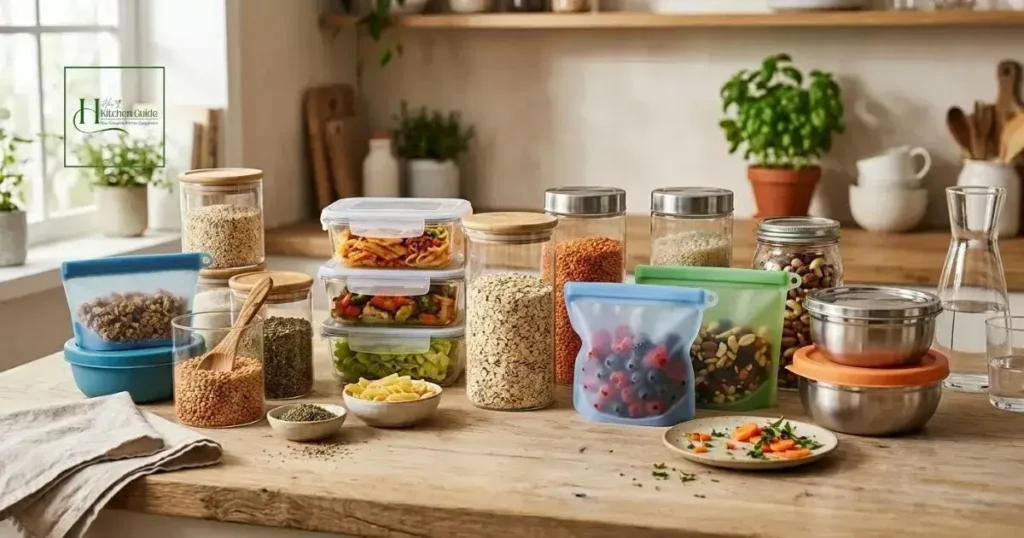
⭐ What’s the best storage container for food?
The best food storage containers are the ones that match how you actually store and use food. Before buying, pay attention to the material, lid and seal, size, durability, food compatibility, ease of cleaning, and how easily the containers fit into your kitchen storage space.
Finding the right food storage containers can make a surprisingly big difference in your kitchen. The right containers keep your food organized, make leftovers easier to manage, and help you make better use of your refrigerator and pantry space.
But with so many options available, choosing a set isn’t always as simple as picking the one that looks nicest. Glass, plastic, stainless steel, airtight lids, different shapes and sizes… there are quite a few things to consider before you buy.
If you are shopping for food storage containers especially in Pakistan, it helps to choose options that suit your pantry space, refrigerator shelves, cooking routine and budget.
In this guide, we’ll look at these seven important factors, compare the most common container materials, and help you decide which type makes the most sense for your kitchen.
What Makes a Food Storage Container Good?
A good food storage container should do more than simply hold food.
It should be practical to use, easy to clean, reasonably durable, and suitable for the type of food you usually store. The lid matters just as much as the container itself, especially if you’re storing leftovers in the refrigerator or dry ingredients in your pantry.
There isn’t one material or container style that is perfect for every kitchen. A glass container may be a great choice for some uses, while a lightweight plastic container may be more convenient for others. Stainless steel can also be useful when durability and portability are priorities.
So instead of looking for one “perfect” container, it’s better to choose containers based on what you store, where you store it, and how often you use them.
7 Things to Check Before Buying Food Storage Containers
Before adding a new set of containers to your kitchen, take a moment to check these seven things. They can help you avoid buying containers that look good in the package but don’t work well for your everyday needs.
1. Material
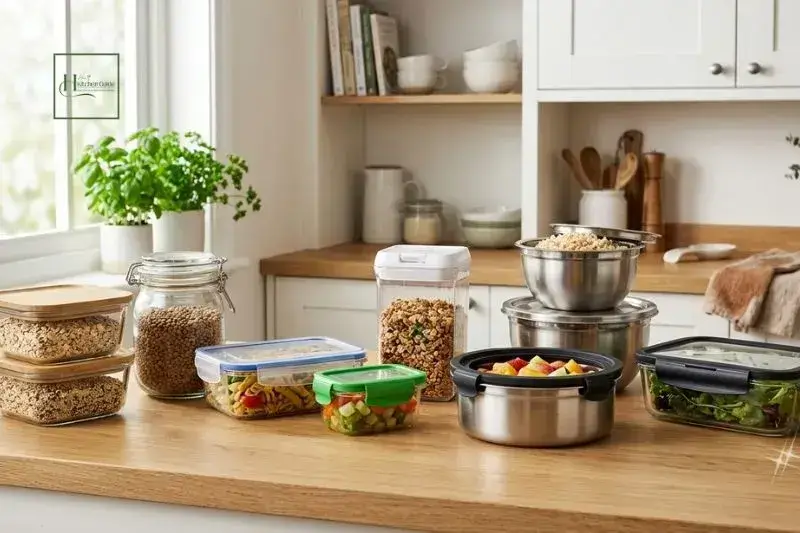
The material is one of the first things to consider because it affects the container’s weight, durability, care requirements, and everyday use.
The most common choices include glass, plastic, and stainless steel, while silicone is also used for certain food storage needs.
Glass is often preferred for refrigerator storage and reheating when the specific container is designed for that purpose. Plastic containers are lightweight and convenient, especially when you need several containers for everyday use. Stainless steel is durable and useful for certain storage and carrying needs.
Don’t choose a material simply because it is labelled “eco-friendly” or “safe.” Look at the actual construction, intended use, care instructions, and whether the product is specifically made for food contact.
Kitchen Tip:
Instead of buying a large set of one type, think about your routine first. A small combination of different container types may be more useful than a cupboard full of containers you rarely use.
2. Lid and Seal
A good container is only as useful as its lid. Even a sturdy container can become frustrating if the lid is difficult to close, doesn’t fit properly, or leaks when you move it.
When choosing food storage containers, look for lids that are easy to open and close but still create a secure seal. This is especially important for foods with sauces, gravies, or other liquids.
For dry foods such as flour, rice, lentils, sugar, or spices, a well-fitting lid can also help keep the contents protected from moisture and everyday kitchen exposure.
Keep in mind that airtight and leakproof are not always the same thing. A container can have a tight seal without being designed to prevent liquid from leaking when it is turned upside down. Always check the manufacturer’s description if this feature matters to you.
3. Size and Shape
Bigger isn’t always better when it comes to food storage containers.
A very large container may seem useful when you’re shopping, but it can take up unnecessary space in your refrigerator or pantry. On the other hand, containers that are too small may leave you struggling to fit leftovers or larger portions.
A practical kitchen usually benefits from having a mix of small, medium, and larger sizes.
Small containers work well for sauces, chopped ingredients, snacks, and small portions. Medium containers are useful for leftovers and prepared foods, while larger ones can be handy for storing bulk dry ingredients or bigger portions.
Shape matters too. Stackable, straight-sided containers can make better use of shelf space than containers with awkward shapes.
💡 Her Kitchen Guide Tip
Before buying a large container set, check the shelves and drawers where you plan to store them. A container that fits perfectly in the shop may not fit comfortably in your refrigerator or kitchen cabinet.
4. Durability
Food containers are used frequently, so durability matters more than you might expect.
Think about how often you’ll be washing and using them, whether they’ll be stored in the refrigerator, and whether they’ll be carried to work or school. A container that is used every day needs to handle regular use without becoming difficult to clean or close.
Also pay attention to the lid and its closure mechanism. Sometimes the container itself remains perfectly usable while the lid becomes the weak point.
If you’re buying a set, don’t just count how many pieces are included. A smaller set of well-made containers can be more useful than a large set with pieces you rarely need.
5. Food Compatibility
Not every container is suitable for every type of food or every storage situation.
Before using a container, check the manufacturer’s instructions for its intended purpose. Some containers are designed for refrigerator storage, while others may be suitable for freezer, microwave, or dishwasher use.
This is particularly important when buying plastic containers. Look for products specifically intended for food contact and follow the manufacturer’s instructions rather than assuming a container is suitable for heating simply because it can hold food.
For acidic, oily, or strongly coloured foods, the material can also affect how easy the container is to maintain over time.
6. Cleaning and Maintenance
If a container is difficult to clean, there’s a good chance it will eventually end up sitting unused in your cupboard.
Look for containers with smooth interiors and lids that don’t have unnecessarily complicated parts. If the lid has a gasket or sealing ring, check whether it can be removed and cleaned properly.
Dishwasher compatibility can also be useful if you rely on a dishwasher, but always follow the manufacturer’s care instructions.
For everyday kitchen use, easy cleaning is not a small detail. It’s one of the things that determines whether you’ll actually keep using the container.
7. Storage and Everyday Convenience
The best food storage container isn’t necessarily the one with the most features. It is the one that fits easily into your everyday routine.
Think about how you normally use containers in your kitchen. Do you store leftover curry in the refrigerator? Keep rice and lentils in the pantry? Pack lunch for work or school? Or prepare ingredients ahead of time?
Your answer can help you decide which container styles are actually worth buying.
For example, stackable containers can be useful when refrigerator or cabinet space is limited. Clear containers make it easier to see what’s inside without opening every lid. Containers that nest inside one another can also save valuable cupboard space when they’re not being used.
If you are organizing a small kitchen, these pantry organization ideas for small kitchens can help you make better use of shelves, containers and everyday storage. The goal isn’t to have the biggest collection of containers. It’s to have a practical selection that keeps your food organized without taking over your storage space.
Which Material Is Best for Food Storage Containers?
There is no single material that works best for every type of food storage.
Glass, plastic, and stainless steel each have different strengths. The right choice depends on what you’re storing, where you’ll keep it, and how you plan to use the container.
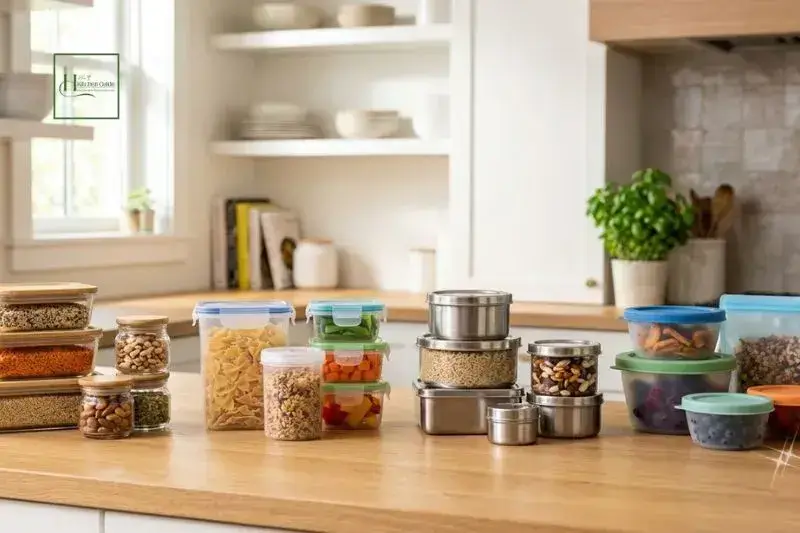
Here’s a quick look at the most common options:
| Material | Best For | Main Advantage | Things to Consider |
|---|---|---|---|
| Glass | Leftovers, refrigerator storage | Easy to see contents and generally easy to clean | Heavier and breakable |
| Plastic | Everyday storage, lunches, lightweight use | Lightweight and available in many sizes | Quality and intended use vary |
| Stainless Steel | Dry foods, lunch storage, portability | Durable and long-lasting | Contents are not visible and not every container is microwave safe |
| Silicone | Flexible storage and certain food uses | Flexible and space saving | Quality and intended use vary |
The table gives you a starting point, but the details matter when you’re choosing containers for your own kitchen.
Glass Food Storage Containers
Glass containers are a popular choice for storing leftovers and prepared foods. They’re transparent, so you can quickly see what’s inside, and they’re generally straightforward to clean.
One of their biggest advantages is versatility when the specific product is designed for the intended use. Some glass containers are made for refrigerator, freezer, microwave, or oven use, but you should always check the manufacturer’s instructions before using them in these ways.
Glass is also heavier than plastic, which can make it less convenient if you’re carrying containers regularly.
For general information about materials intended to come into contact with food, see the European Commission’s food contact materials guidance.
Plastic Food Storage Containers
Plastic containers are popular because they’re lightweight, easy to handle, and available in a wide range of sizes and shapes.
They’re particularly convenient for everyday storage, lunch boxes, and situations where carrying a heavier glass container isn’t practical.
However, don’t assume that every plastic container is suitable for every purpose. Check whether the product is intended for food contact and follow the manufacturer’s instructions regarding microwave, freezer, dishwasher, and temperature use.
It’s also worth paying attention to the condition of older containers. If a container becomes badly scratched, cracked, warped, or otherwise damaged, it’s sensible to replace it rather than continuing to rely on it.
When choosing plastic containers, look for products clearly intended for food contact and follow the manufacturer’s instructions for microwave, freezer and dishwasher use. For general information about food contact substances, see the FDA guidance on packaging and food contact substances.
Stainless Steel Food Storage Containers
Stainless steel containers are valued mainly for their durability. They’re lightweight compared with glass and don’t have the same breakage concern, making them useful for lunch storage, carrying food, and certain pantry needs.
They’re particularly practical when you want a container that can handle regular use without being fragile.
The main drawback is visibility. Unlike glass, you can’t see the food without opening the lid. This may not matter for lunch boxes or dry storage, but it can be less convenient when you’re trying to quickly identify leftovers in the refrigerator.
Also, don’t assume that every stainless steel container is suitable for every food or storage condition. Check the manufacturer’s instructions for the specific product.
Food-Grade Silicone Containers
Silicone can be useful when flexibility and space-saving are important.
Some silicone food storage products can be folded or compressed when empty, making them convenient for kitchens where cupboard space is limited. They can also be useful for certain types of food storage and meal preparation.
As with other materials, “silicone” alone doesn’t tell you everything about a product’s suitability. Check that the product is intended for food use and follow its temperature and care instructions.
💡 Her Kitchen Guide Tip:
Don’t feel that you need to choose just one material for your entire kitchen. A combination can often work better: glass for leftovers, lightweight plastic for everyday carrying, stainless steel for durability and portability, and silicone where flexibility is genuinely useful.
The best set is the one that matches your routine rather than simply having the highest number of pieces.
Glass vs. Plastic vs. Stainless Steel: Which Should You Choose?
Choosing between glass, plastic, and stainless steel usually comes down to how you plan to use your containers. Each material has its own advantages, and there’s no reason your kitchen can’t use more than one.
Glass vs. Plastic
Glass is heavier, but it is a good option when you want a sturdy container for refrigerator storage and easy visibility. You can see what’s inside without opening the lid, which is especially helpful when you have several leftovers stored at once.
Plastic, on the other hand, is lightweight and convenient. It’s often easier to carry for lunches, picnics, or everyday use. The important thing is to choose containers intended for food storage and follow the manufacturer’s instructions for their specific use.
If you’re trying to keep your kitchen practical and organized, having a few glass containers for leftovers and a few lightweight plastic ones for everyday carrying can give you the best of both worlds.
Glass vs. Stainless Steel
Both glass and stainless steel can be durable choices, but they serve different purposes.
Glass makes it easy to see your food and can be convenient for refrigerator storage. Stainless steel is lighter and more resistant to breakage, making it useful when portability and durability matter more.
The trade-off is visibility. With stainless steel, you’ll need to open the container to see what’s inside.
Plastic vs. Stainless Steel
Plastic is generally more convenient when you want lightweight containers in different shapes and sizes. Stainless steel is a good option when durability and repeated everyday use are priorities.
For example, stainless steel can make sense for a lunch container that needs to travel regularly, while plastic may be more convenient when you need several lightweight containers for general kitchen use.
A Simple Way to Choose
If you’re still unsure, this simple guide can help:
- Choose glass if visibility and refrigerator storage are your priorities.
- Choose plastic if you want lightweight and convenient everyday containers.
- Choose stainless steel if durability and portability matter most.
- Consider using a combination if your kitchen needs vary.
There is no prize for choosing only one material. In fact, a small collection of different types can often be more useful than a large matching set.
💡 Her Kitchen Guide Tip:
Before buying a new set, look at the containers you already own. You may not need more containers overall. You may simply need a few better sizes, better-fitting lids, or a material that suits a particular storage need.
If you’re also working on making your kitchen more functional, small changes in how you arrange everyday items can make a noticeable difference. Our guide to Pantry Organization Ideas for Small Kitchens has more practical ideas for making better use of limited storage space.
Are Airtight Containers Better for Food Storage?
Airtight containers are especially useful when you want to protect dry foods from moisture and everyday exposure.
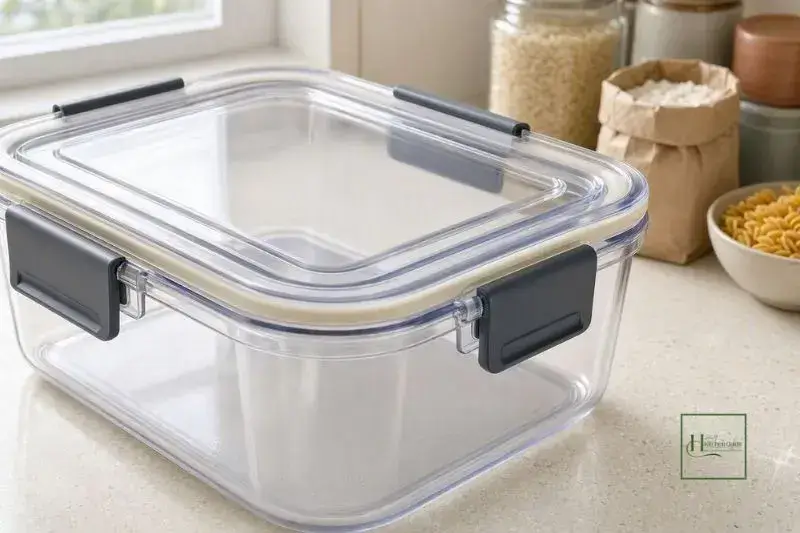
The basic idea is simple: an airtight container has a lid and sealing mechanism designed to limit the exchange of air between the inside and outside of the container.
But airtight doesn’t automatically mean that food will stay fresh indefinitely. The container is only one part of proper food storage. The type of food, moisture, temperature, handling, and storage time all matter too.
Airtight containers can be particularly useful for pantry staples such as:
- Rice
- Flour
- Sugar
- Lentils
- Pasta
- Cereals
- Dry snacks
- Baking ingredients
For foods that need protection from moisture or pantry pests, a properly sealed container can be a practical choice.
It’s also worth remembering that airtight and leakproof are different features. An airtight seal is primarily about limiting air exchange, while a leakproof design is intended to prevent liquids from escaping. If you need a container for soups, curries, or other liquid foods, check the manufacturer’s description for leakproof performance rather than assuming that “airtight” guarantees it.
For general food-contact safety and packaging information, the FDA’s Food Ingredients & Packaging guidance is a useful authoritative reference.
When Should You Use Airtight Containers?
Airtight containers make the most sense when the goal is to keep dry ingredients protected from humidity, air exposure, and common pantry problems.
They’re less about having a fancy container set and more about matching the container to the food you’re storing.
For example, keeping flour or sugar in a well-sealed container can be much more practical than leaving an opened packet loosely folded in a cupboard.
And if you’re already trying to make your kitchen more organized, choosing containers that stack neatly and have secure lids can help you keep both the food and the storage space under control.
What Container Sizes Do You Actually Need?
It can be tempting to buy a large set with every size available, but most kitchens don’t need dozens of containers. A few well-chosen sizes are usually enough for everyday food storage.
The right sizes depend on what you normally cook and store. A family that regularly prepares large portions will have different needs from someone cooking for one or two people.
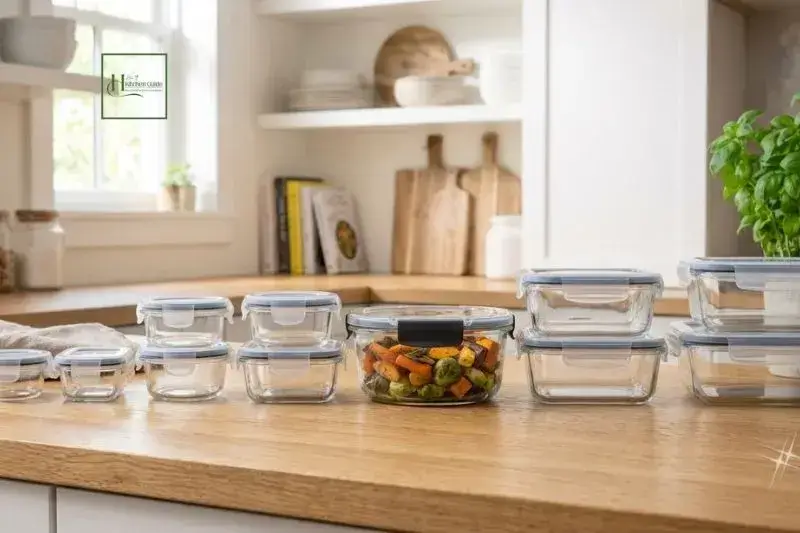
Here is a practical starting point:
| Container Size | Useful For |
|---|---|
| Small | Chutneys, sauces, nuts, snacks, small portions |
| Medium | Leftovers, cooked vegetables, fruits, lunch portions |
| Large | Rice, pasta, cooked meals, larger food portions |
| Extra Large | Bulk dry ingredients or larger family-sized quantities |
Small Containers
Small containers are useful for foods that don’t need much space. You can use them for chutneys, sauces, chopped ingredients, nuts, snacks, or small leftover portions.
They can also help prevent a small amount of food from getting lost in a large container, which can make refrigerator storage less efficient.
Medium Containers
For most households, medium-sized containers are probably going to get the most everyday use.
They’re practical for storing leftover curry, cooked vegetables, rice, fruit, or portions prepared for the next meal.
If you regularly cook more than one dish at a time, having several medium containers can make refrigerator organization much easier.
Large Containers
Large containers are useful when you’re storing family-sized portions or bulk ingredients.
They can work well for foods such as rice, flour, pasta, lentils, cereal, or larger quantities of prepared food. However, check the dimensions before buying because a container’s capacity doesn’t tell you whether it will actually fit comfortably on your shelf.
Don’t Ignore the Shape
Capacity isn’t the only thing that matters.
Two containers can hold a similar amount of food but take up very different amounts of space. Tall, narrow containers can make better use of some pantry shelves, while wider containers may be easier to access.
For refrigerators, stackable containers can be particularly useful because they help you use vertical space instead of spreading everything across the shelves.
If you’re dealing with limited kitchen space, our guide on Kitchen Countertop Organization also has practical ideas for keeping frequently used items from taking over your available workspace.
💡 Her Kitchen Guide Tip:
Before buying containers, measure your refrigerator shelves and the pantry areas where you plan to use them. A container that fits your food but doesn’t fit your storage space isn’t really a practical choice.
Best Food Storage Containers for Different Kitchen Needs
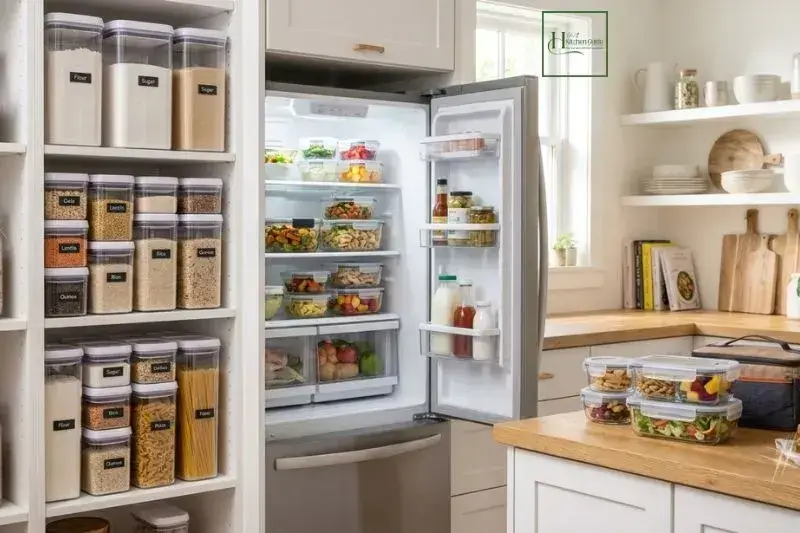
Instead of asking, “Which food container is the best?” it can be more useful to ask, “Which container is best for what I need to store?”
Different foods and situations call for different features.
Best for Leftovers
For leftovers, choose containers that are easy to clean, have secure lids, and fit comfortably in your refrigerator.
Glass can be a practical option because you can see the food inside, which makes it easier to identify leftovers without opening multiple containers.
If you’re storing liquid foods such as curry or soup, make sure the lid is designed to provide a secure closure and check whether the container is specifically described as leakproof.
If you often cook for guests or family gatherings, keeping a few leakproof containers ready can make leftovers much easier to manage. You may also find these stress free kitchen tips for family gatherings helpful.
Best for Dry Ingredients
Dry ingredients benefit from containers that close securely and protect their contents from moisture.
Airtight containers can be particularly useful for pantry staples such as flour, sugar, rice, lentils, pasta, and cereals.
For larger quantities, choose a size that leaves enough room for comfortable scooping without making the container unnecessarily large.
Best for Refrigerator Storage
For refrigerator storage, shape and visibility become especially important.
Clear containers make it easier to see what you already have, while stackable designs can help you make better use of shelf space.
Try to avoid buying containers that are much larger than the portions you usually store. Oversized containers can take up valuable refrigerator space unnecessarily.
Best for Lunches and On-the-Go Meals
For lunches, weight and portability matter more.
A lightweight container with a secure lid is generally easier to carry than a heavy glass container, particularly if you’re packing food for school or work.
If you’re carrying sauces or liquid foods, pay particular attention to the lid and closure rather than choosing a container based only on its material.
Best for Pantry Storage
For pantry storage, focus on secure lids, suitable capacity, stackability, and easy identification.
Transparent containers can make it easier to see when you’re running low on an ingredient. If you use several containers for similar ingredients, labels can also make your pantry easier to manage.
This can be especially helpful when organizing staples such as rice, flour, sugar, pulses, and pasta.
A well-organized pantry isn’t just about making it look neat. It can also make everyday cooking easier because you can quickly find what you need.
Storage Tips for Hot and Humid Weather
In hot or humid weather, keep dry ingredients completely dry before transferring them to containers. Make sure lids are closed properly and avoid placing containers close to the stove, sink or areas with regular steam.
For flour, rice, lentils, spices and dry snacks, choose containers with a secure lid and clean the shelf regularly. If you notice moisture, unusual smells, insects or spoilage, empty the container, clean and dry it fully before refilling it.
How to Store Leftovers Safely
A container helps keep food organized, but food safety also depends on cooling and refrigerating leftovers promptly.
For cooked food, divide large portions into smaller or shallow containers so they cool more quickly. Refrigerate perishable leftovers within two hours. If the weather is very hot and the temperature is above 90°F or 32°C, refrigerate them within one hour.
Label containers with the dish name and date, and avoid leaving leftovers at room temperature for long periods. A secure lid is useful, but it does not make food safe if the food has been left out too long.
For more detailed advice, see FoodSafety.gov guidance on storing leftovers.
Food Storage Containers in Pakistan: Brands and Where to Buy
If you’re shopping for food storage containers in Pakistan, you’ll find plenty of choices, from simple plastic sets to glass and stainless steel containers. Prices can vary quite a bit depending on the material, size, number of pieces, lid design, and the seller.
Food Storage Container Brands to Consider in Pakistan
If you’re shopping for food storage containers in Pakistan, you’ll come across a mix of local brands, imported options, and products available through major kitchenware retailers. The right choice depends on your preferred material, storage needs, and budget.
Here are some names worth exploring:
Appollo
Appollo is a Pakistani plasticware brand that offers plastic storage containers, canisters, and kitchen organizers in different sizes. Some listed products are described by the brand as BPA free and intended for food storage, so check the material details, capacity and care instructions for the specific item before ordering.
You can browse its container collection directly at Appollo to see the available sizes and designs.
Lion Star
Lion Star is an imported houseware brand that is available in Pakistan and is known for plastic food keepers and pantry storage containers. Its range includes options designed for airtight food storage.
If you’re mainly looking for plastic containers for pantry organization, Lion Star is one of the names you may come across when shopping locally.
Lock & Lock
Lock and Lock is worth comparing if you prefer containers with locking lids. Its range includes plastic and glass food storage options, but always check the specific product details for capacity, microwave or freezer suitability and lid type before buying.
The brand is particularly worth considering if a secure, leak-resistant closure is high on your list of priorities.
You can check currently available options through Al-Fatah’s food storage collection.
Pyrex
If you prefer glass food storage containers, Pyrex is a widely known glassware brand to compare. Check the care instructions for the specific container, especially before using it in an oven, microwave or freezer.
Pyrex options may also be available through Pakistani retailers such as Naheed.
PrettyNeat Plastics
PrettyNeat Plastics is a local option offering practical food storage products, including modular clip storage boxes and round or square food keepers.
Its range may be useful if you’re looking for BPA-free plastic storage containers with a more organized, modular design. You can explore its kitchen collection at PrettyNeat Shop.
Hommold and Idealancy
Hommold and Idealancy are also names you may encounter when browsing kitchen storage products online in Pakistan.
Their ranges include options such as airtight canisters, cereal dispensers, and pantry organization products. These may be worth exploring if your main goal is to organize dry ingredients and make better use of pantry space.
You can browse Hommold’s kitchen storage collection or Idealancy’s food storage range to see their current offerings.
Where Can You Shop for Food Storage Containers in Pakistan?
Besides individual brands, several Pakistani retailers carry a variety of food storage products, which can make comparison easier.
Naheed offers a range of food storage products, while Al-Fatah is another option for comparing containers from different brands.
For a wider selection of kitchenware, you can also browse JB Saeed Studio’s containers and jars collection.
💡 Her Kitchen Guide Tip:
Don’t choose a brand simply because its name is familiar. Compare the material, container size, lid design, intended use, and current price of the specific product you’re considering. A good container for pantry storage may not be the best choice for leftovers or lunch packing.
A Quick Comparison
| Brand | Main Options | Worth Considering For |
|---|---|---|
| Appollo | Plastic containers, canisters, organizers | Affordable everyday storage |
| Lion Star | Plastic food keepers, pantry containers | Pantry and dry-food storage |
| Lock & Lock | Plastic and glass containers | Secure lids and everyday storage |
| Pyrex | Glass storage dishes and containers | Glass food storage and meal prep |
| PrettyNeat Plastics | Modular plastic storage boxes | Organized pantry and kitchen storage |
| Hommold | Canisters, dispensers, storage products | Pantry organization |
| Idealancy | Airtight canisters and storage products | Dry-food and pantry storage |
Prices and availability can change, especially across online retailers, so it’s better to check the current product listing before making a purchase.
Stores and Options to Compare in Pakistan
Food storage containers are available through local kitchenware shops, homeware stores, supermarkets and online marketplaces. When shopping online, focus on the exact product description rather than only the product photo.
You can compare available styles and sizes through marketplaces such as Daraz Pakistan, as well as homeware retailers that sell plastic, glass and pantry storage containers.
Before ordering, check the listed material, capacity in millilitres or litres, number of actual containers, lid style, care instructions, seller rating and return policy. Availability and prices can change, so always check the current product page before purchasing.
Rather than choosing a container set based only on its price or the number of pieces in the box, compare the features that actually matter for your kitchen.
What Should You Look for When Buying in Pakistan?
Before buying, check:
- Material: Decide whether glass, plastic, or stainless steel suits your needs.
- Lid quality: Make sure the lid closes securely and is easy to use.
- Size: Look for sizes that match the foods you normally store.
- Set contents: A 10-piece set isn’t necessarily better than a 5-piece set if several pieces will remain unused.
- Care instructions: Check whether the containers are suitable for the dishwasher, freezer, microwave, or other uses you need.
- Seller information: When shopping online, check the product specifications, seller details, and customer reviews before ordering.
Food Storage Containers Price in Pakistan
There isn’t one fixed price for food storage containers in Pakistan. The cost can change based on the material, capacity, brand, number of containers, and seller.
As a general approach, you can think of the market in three broad categories:
| Price Range | What You May Find | Best for |
|---|---|---|
| Budget | Basic plastic containers and smaller sets | Snacks, leftovers and small dry goods |
| Mid-range | Better-quality plastic sets, glass containers, and more durable designs | Everyday pantry and fridge storage |
| Premium | Branded glass or stainless steel sets and containers with more specialized features | Long term use, meal prep and organized kitchens |
Prices change depending on the seller, city, discounts, material, capacity, lid design and number of pieces. These categories are only a general guide, so check the current listing before buying and compare products with similar sizes and features.
If you’re comparing products on marketplaces such as Daraz, don’t look at the price alone. Compare the container’s material, capacity, number of pieces, lid design, and seller rating so you’re comparing like with like.
Should You Buy a Complete Set or Individual Containers?
A complete set can be convenient because you get several sizes that are designed to work together. It can also make your kitchen look more organized when the containers stack neatly.
But buying individual containers can sometimes be the smarter option.
If you already have several containers at home, replacing only the sizes you’re missing can save money and cupboard space. For example, you might already have plenty of small containers but need a few larger ones for family-sized portions.
💡 Her Kitchen Guide Tip:
Before ordering a new set online, count the containers you already own and note which sizes you actually use most often. This simple step can stop you from buying another set full of pieces you don’t need.
Common Mistakes to Avoid When Buying Food Storage Containers
A container can look perfect online and still turn out to be inconvenient in everyday use. These are some common mistakes worth avoiding.
Buying Too Many Containers
More containers don’t automatically mean better organization.
If your kitchen cupboards are already crowded, adding another large set can make storage even harder. Start with the sizes you actually use and build your collection gradually.
Choosing Containers Only by Appearance
A stylish container may look great, but appearance shouldn’t be your main deciding factor.
Check the material, capacity, lid, care instructions, and dimensions before making your decision.
Ignoring the Lid
Many people focus on the container itself and barely check the lid.
That’s a mistake. A lid that is difficult to close, difficult to clean, or doesn’t seal properly can make an otherwise good container frustrating to use.
Buying the Wrong Size
A container that’s too large wastes storage space, while one that’s too small may not hold a normal portion comfortably.
Think about the foods you usually store before choosing the size.
Assuming Every Container Is Microwave or Freezer Safe
Never assume a container is suitable for heating or freezing just because it holds food.
Check the manufacturer’s instructions for the specific product. This is particularly important for plastic containers and glass containers.
For more information about food packaging and materials intended for food use, you can refer to the FDA’s guidance on Food Ingredients & Packaging.
Buying Based Only on the Number of Pieces
A “24-piece set” may sound like a great deal, but remember that lids are often included in the piece count.
Look at the actual number of containers, their sizes, and whether those sizes are useful for your kitchen.
Quick Buying Checklist
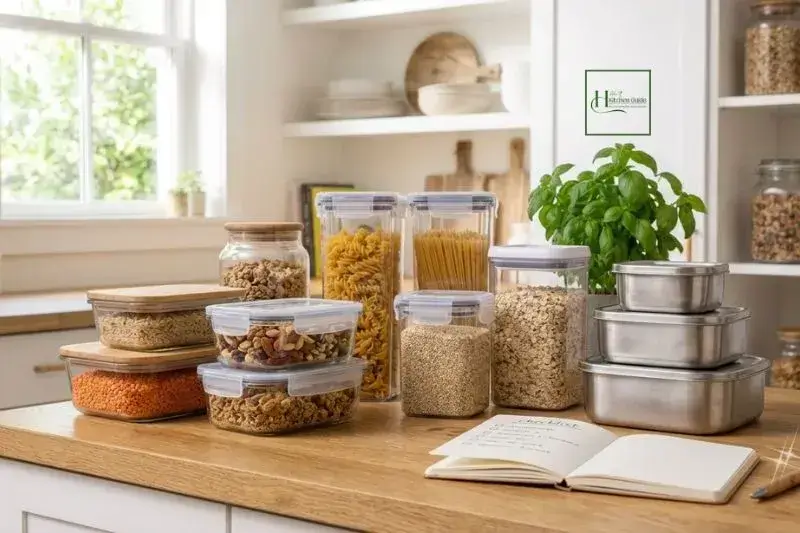
Before you click Buy, run through this quick checklist:
☐ Is the material suitable for the way I plan to use it?
☐ Does the lid close securely?
☐ Do I need an airtight or leak-resistant design?
☐ Are the sizes suitable for my usual portions?
☐ Will the containers fit in my refrigerator or pantry?
☐ Are they easy to clean?
☐ Are they suitable for the specific temperature or appliance use I need?
☐ Am I buying useful pieces, or simply buying a large set because it looks like a better deal?
FAQs About Food Storage Containers
Choosing food storage containers can bring up a lot of small questions, especially when you’re comparing different materials, sizes, and lid styles. Here are some of the most common ones.
Which container is best for storing food?
There isn’t one container that’s best for every type of food. Glass, plastic, and stainless steel can all be useful, depending on what you’re storing and how you plan to use the container.
For refrigerator leftovers, glass can be a practical choice. Lightweight plastic can be convenient for everyday carrying, while stainless steel is useful when durability and portability are priorities.
What should I look for in a food storage container?
Look for clear material information, instructions showing that the container is intended for food contact, a lid that suits your purpose and care guidance for the refrigerator, freezer, microwave or dishwasher where needed. The best material depends on how you plan to use the container.
The U.S. Food and Drug Administration provides information on food ingredients, packaging, and materials that come into contact with food in its Food Ingredients & Packaging guidance.
Are glass containers better than plastic?
Not necessarily. Glass has advantages such as visibility and easy cleaning, but it is heavier and can break. Plastic is lightweight and convenient, particularly when containers need to be carried around.
The better choice depends on your kitchen routine rather than the material alone.
Are stainless steel containers safe for food storage?
Stainless steel containers designed for food storage can be a practical option, particularly for dry foods, packed meals, and situations where durability matters.
However, check the manufacturer’s instructions for the specific container, especially if you’re storing acidic foods or using the container for a particular type of food.
Are airtight containers good for food storage?
Yes, airtight containers can be particularly useful for dry pantry foods because a secure seal helps limit exposure to air and moisture.
However, an airtight container doesn’t make food last indefinitely. Proper storage conditions and the type of food still matter.
Which food storage containers are best for long-term storage?
For longer-term pantry storage, choose containers with secure lids, suitable capacity, durable construction, and a design that protects the contents from moisture and everyday exposure.
For dry staples such as rice, flour, lentils, and pasta, a properly sealed container can be a practical choice. Always consider the recommended storage conditions for the particular food rather than relying on the container alone.
What size food storage containers should I buy?
A combination of small, medium, and large containers is usually more useful than buying only one size.
Small containers are handy for sauces and small portions, medium ones work well for leftovers, and larger containers can be useful for family-sized portions or bulk dry ingredients.
Where can I buy food storage containers in Pakistan?
Food storage containers are widely available through supermarkets, kitchenware stores, online marketplaces, and brand-specific retailers in Pakistan.
When shopping online, compare the material, dimensions, capacity, lid design, number of actual containers, seller information, and current price rather than choosing based only on the product image.
Final Thoughts
The best food storage containers aren’t necessarily the most expensive ones or the set with the largest number of pieces.
What matters is whether they work for your food, your kitchen, and your everyday routine.
Before buying, pay attention to the seven things we’ve covered: material, lid and seal, size and shape, durability, food compatibility, cleaning, and storage convenience. Once you know what you actually need, choosing between glass, plastic, stainless steel, or airtight containers becomes much easier.
And remember, you don’t have to replace everything at once. Start with the sizes and types you’re missing, and build a collection that makes storing and organizing food simpler.
A few practical containers that you use every day are far more valuable than a cupboard full of containers that simply take up space.
If you are building your kitchen from scratch, see our guide to must have kitchen utensils for every home cook.
More Kitchen Guides You May Like
If you’re working on making your kitchen more organized and practical, you may also enjoy:
- Pantry Organization Ideas for Small Kitchens for making better use of limited pantry space.
- Kitchen Countertop Organization for keeping everyday kitchen items neat and accessible.
- Must-Have Kitchen Utensils if you’re also deciding which essential tools are worth having in your
📌 Save this guide on Pinterest for easy reference when choosing food storage containers for your pantry, fridge and leftovers.
📘 Follow Her Kitchen Guide on Facebook for practical kitchen tips, easy recipes and simple organization ideas.
📷 Follow Her Kitchen Guide on Instagram for quick kitchen inspiration, behind-the-scenes tips, and everyday organization ideas.
Explore More Kitchen Guides
Looking for more practical kitchen tips, appliance buying guides, and easy recipes? Browse our latest articles and discover more helpful kitchen guides.